
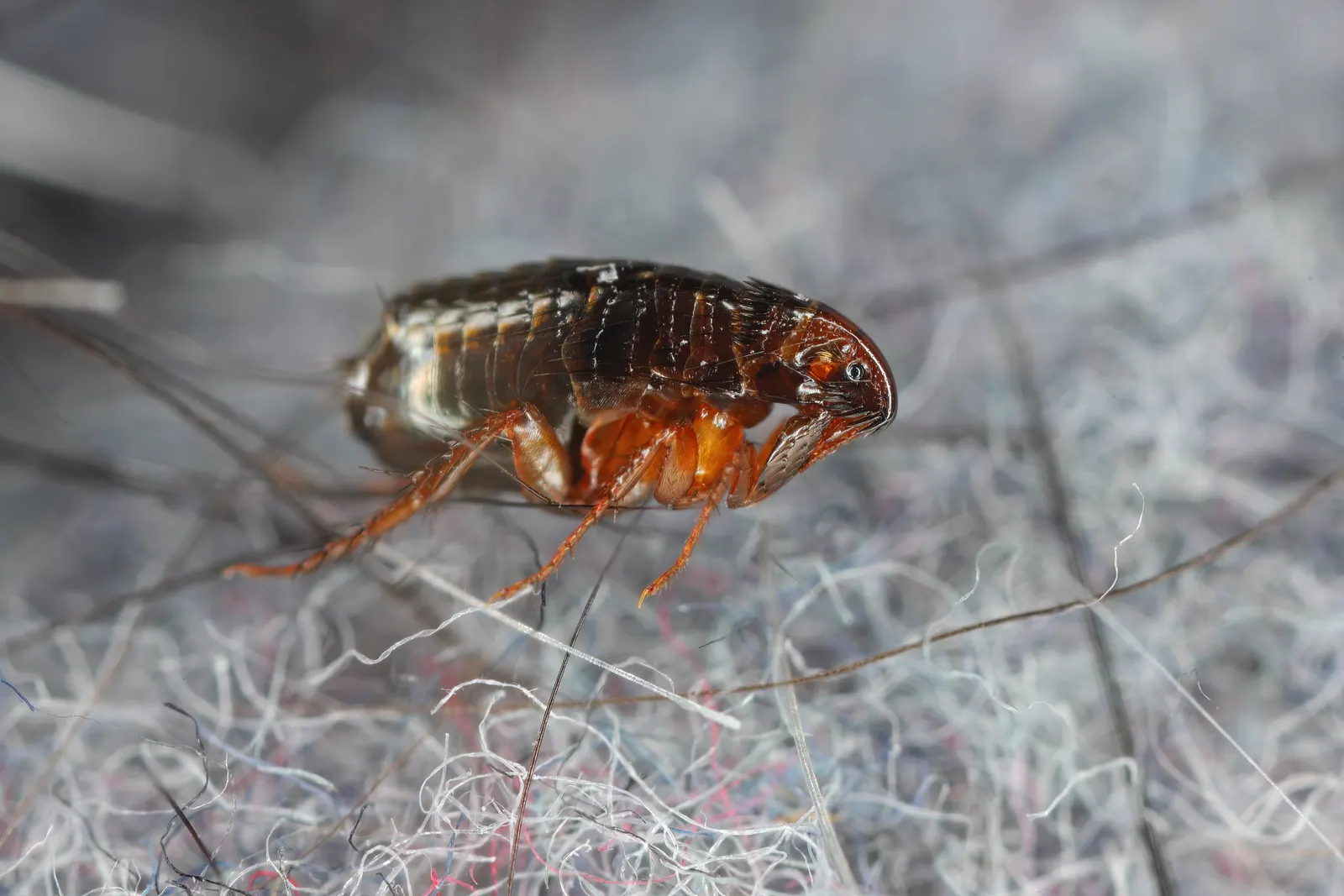
Here’s the fact that explains every failed flea battle: the adult fleas on your pet and biting your ankles are roughly 5% of the infestation. The other 95% — eggs, larvae, and cocooned pupae — is distributed invisibly through your carpet, pet bedding, couch cushions, and floor cracks, on a staggered schedule that guarantees reinforcements for weeks. Kill every adult flea in the house today and you have not ended the infestation; you’ve cleared the current shift.
The life cycle that beats you
The cat flea — the species on dogs and cats alike — runs a four-stage cycle tuned to defeat one-shot responses. The adult lives on the animal, feeding and laying up to 40–50 eggs a day. The eggs don’t stick: they rain off the pet wherever it walks, sleeps, and shakes, concentrating in resting spots. Larvae hatch and burrow down into carpet base, upholstery, and floor gaps, feeding on the dried-blood droppings of the adults (the “flea dirt” that sifts down with the eggs — a complete meal-delivery system).
Then the stage that breaks DIY efforts: the pupa. Larvae spin sticky, debris-camouflaged cocoons that are essentially impervious to insecticides — and inside, a fully formed adult can wait for months, emerging only when heat, carbon dioxide, and vibration announce a host. This is why a vacant house explodes with fleas when a new family moves in, and why fleas “come back” two weeks after a treatment that killed every exposed stage: the cocoons were always going to hatch on their own schedule.
Confirming fleas
On the pet: scratching concentrated at the tail base, neck, and belly; and flea dirt — pepper-like specks in the fur that smear rust-red on a wet paper towel (dried blood — the diagnostic test). A flea comb through the rump fur will produce the evidence directly. On people: itchy bite clusters around ankles and lower legs, often after time in a particular room. White socks walked slowly through a suspect room will show jumping adults against the fabric. And note fleas are more than an itch: they transmit tapeworm to pets (and occasionally children), and heavy infestations can genuinely anemize kittens and puppies.
The three-front protocol that works
Flea elimination succeeds only when the pet, the house, and (when seeded) the yard are handled simultaneously. Any front left open re-seeds the others.
The pet — the flea factory — needs modern veterinary flea control: today’s prescription oral and topical products are dramatically more effective than supermarket collars, powders, and dips, most of which are wasted money. Every pet in the household, treated the same week, per your veterinarian.
The house needs mechanical attack plus correct chemistry. Vacuuming is legitimately a weapon: it removes eggs and larvae, lifts carpet fibers for treatment penetration, and its vibration tricks pupae into hatching early — into the treatment. Daily vacuuming for two weeks (canister emptied outside), all pet bedding hot-washed or replaced. Professional treatment pairs an adulticide with an insect growth regulator (IGR) — the ingredient that breaks the cycle by preventing eggs and larvae from ever maturing, and the ingredient most retail sprays lack. Expect a declining trickle of new adults for up to two weeks post-treatment as the pupal reservoir empties into the residual; that’s the plan, not a failure.
The yard, when it’s part of the story, means treating shaded pet-rest areas and blocking the wildlife (under-deck cats, raccoons, opossums) that reload it.
Household flea work is covered under our general pest control service — and because the “5% visible” math punishes partial efforts, it’s a problem where the coordinated professional version pays for itself in not doing this three times.
Prevention
Year-round veterinary flea prevention on pets (in warm climates, seasonal lapses are how it restarts), washed pet bedding, screened crawl-space vents and closed deck skirting against wildlife, and a skeptical eye on secondhand rugs and upholstered furniture. Fleas are a solved problem in households that keep the host protected — the other 95% never gets its start.