
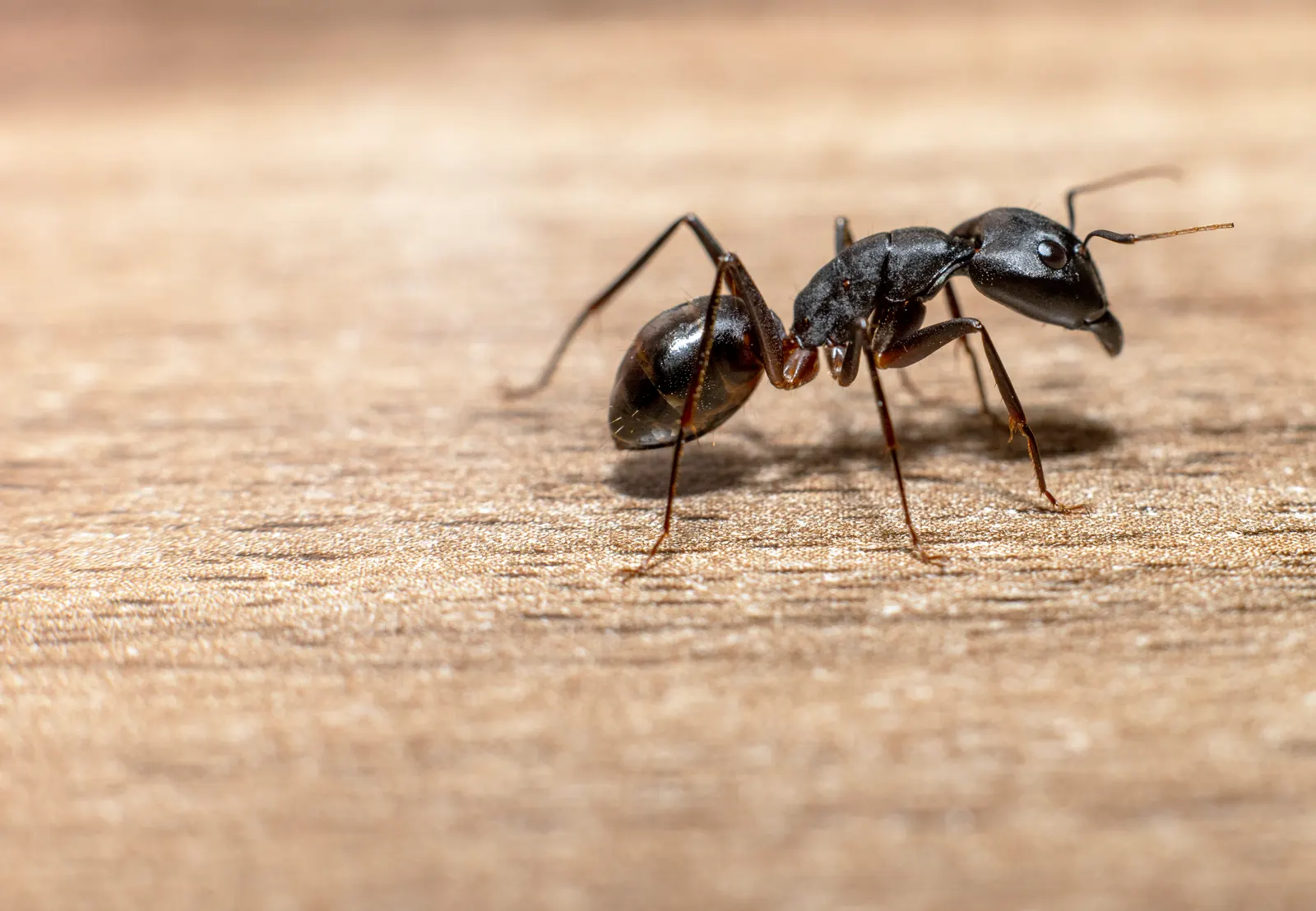
Ants are the number-one pest call in American homes, and the most misunderstood. The reason the problem keeps coming back isn’t persistence — it’s that most treatments never touch the colony. The ants you see are foragers: a small, replaceable fraction of a population that lives somewhere else entirely, run by one or more queens whose only job is to replace everything you kill.
First, identify the ant — the strategy depends on it
Three groups cover most household ant problems, and they need different responses.
Odorous house ants are the small (about 1/8”), dark brown ants that trail into kitchens and bathrooms, especially after rain. Crush one and you’ll get a smell most people describe as rotten coconut — that’s the giveaway. They nest in wall voids, under slabs, and beneath mulch, they love sugar and moisture, and they have a critical quirk: when threatened by repellent sprays, colonies bud — splitting into several daughter colonies. This is the ant that DIY spraying famously makes worse.
Carpenter ants are the large (up to 1/2”) black or black-and-red ants. They don’t eat wood — that’s termites — but they excavate damp, softened wood to nest in, leaving smooth galleries and pushing out piles of fine frass that looks like sawdust mixed with insect parts. Carpenter ants indoors are two problems at once: an insect issue and a moisture issue (a leak, a wet sill, a damp deck ledger) that invited them.
Fire ants live outdoors in the southern half of the country, building dome-shaped mounds in sunny lawns. They’re less a kitchen problem than a safety one: disturb a mound and workers swarm and sting in numbers, which is a genuine medical risk for sensitive kids, pets, and anyone who can’t move away quickly.
Why they’re in your house
Ants come in for three things: food, water, and shelter from weather extremes. A few crumbs are genuinely enough — a forager that finds them recruits nestmates by laying a pheromone trail, which is why one scout on Tuesday becomes a highway by Friday. Entry is easier than most homeowners think: foundation cracks, weep holes, gaps around pipes and cables, and the natural bridges formed by tree limbs, shrubs, and mulch piled against the house.
Why spraying backfires
Retail ant sprays are repellents. They kill the foragers you see and chemically flag the area as dangerous — so the colony avoids the spot, reroutes, and (in budding species like odorous house ants) may split into multiple colonies as a survival response. You get a clean counter for a week and a bigger problem in the walls.
Professional ant control works the opposite way: non-repellent materials ants can’t detect, and baits formulated so foragers carry them back and feed the colony — including the queens. It’s deliberately slow. Bait that killed on contact would never reach the nest. Expect several days of visible (even increased) activity, then collapse.
Prevention that actually moves the needle
- Control moisture. Fix drips, ventilate crawl spaces, and keep gutters flowing — odorous house ants and carpenter ants both follow water.
- Break the bridges. Trim branches and shrubs off the roof and siding; keep mulch a few inches shy of the foundation.
- Seal the obvious. Caulk gaps at pipes, cables, windows, and door thresholds. You won’t get every crack, but you’ll close the highways.
- Starve the trail. Wipe counters, sweep under appliances, keep sweets and pet food in sealed containers. This makes professional baits dramatically more effective — bait competes with crumbs.
- Don’t spray trails. If you must do something before help arrives, clean the trail with soapy water. Never use repellent spray on small brown ants.
When to call a professional
Call when ants persist after a serious sanitation effort, when they return every season, when you see large black ants or frass piles indoors (possible carpenter ants — worth an inspection of the moisture story), or when fire ant mounds appear where kids and pets play. A technician will identify the species, locate the nesting story, and use colony-level treatments that end the problem rather than redecorating it — it’s the core of our ant control service, and it’s included year-round in our recurring home protection plan.
One more identification note worth its own sentence: winged “ants” swarming indoors in spring may actually be termites — elbowed antennae and pinched waists mean ants; straight antennae and thick waists mean termites, and that’s an inspection you shouldn’t postpone.