
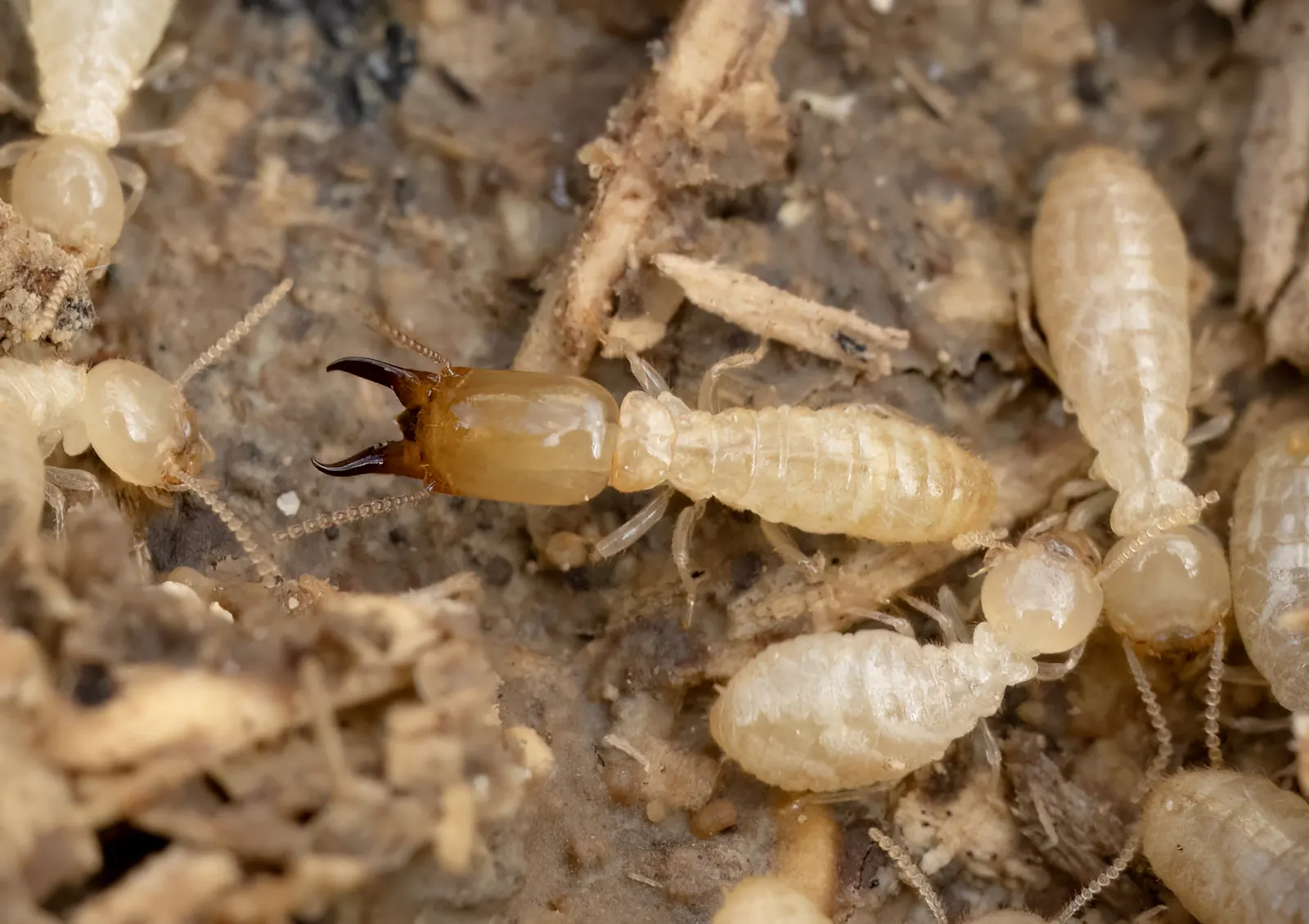
Termites are the rare pest where the stakes are financial before they’re emotional. They don’t bite, don’t spread disease, and you may never see one — but subterranean termites damage on the order of 600,000 U.S. homes a year, the repair bill runs into the billions, and homeowners insurance almost universally excludes it as “preventable.” Everything about managing termites follows from one fact: they work invisibly, from the inside of the wood outward, often for years before discovery.
Know your enemy: the subterranean termite
Across most of the country, the termite that matters is the eastern subterranean termite. The colony lives in the soil — not in your house — and can number in the hundreds of thousands. Workers travel from soil to wood through foundation gaps, expansion-joint cracks, plumbing penetrations, and the mud tubes they build up foundation walls; they need moisture, which is why they commute back to damp ground and why moisture problems around a foundation raise risk so sharply.
They eat cellulose: framing, sill plates, subfloors, but also cardboard boxes in the crawl space, buried construction scrap, stumps, and mulch. To a colony, your house is simply the largest piece of dead wood in the neighborhood.
The signs that matter
- Mud tubes. Pencil-width tunnels of soil climbing foundation walls, piers, or crawl-space supports — the single most reliable evidence. Break a section open; if it’s repaired within days, the colony is active.
- Swarmers and wings. Once a colony matures, it releases winged reproductives — usually on a warm day after rain, most often in spring. A swarm inside the house, or piles of identical shed wings at windowsills, is near-certain evidence of an established colony in or under the structure.
- Hollow or blistered wood. Termites eat along the grain, leaving a thin painted shell. Wood that sounds papery when tapped, or paint that bubbles and ripples for no moisture reason, deserves a screwdriver test — gently probe, and if it gives way to reveal layered galleries packed with dried mud, you’ve found them.
- Stuck doors and sagging floors in advanced cases — though plenty of other things cause these, which is why evidence-gathering beats guessing.
What you will not usually see: termites themselves. Workers are pale, soft-bodied, and die quickly in open air. No visible insects means nothing either way.
Why DIY doesn’t apply here
Termites are the least DIY-appropriate pest in the house. The colony is in the soil, potentially dozens of feet away; the treatments that work — continuous liquid soil barriers with non-repellent chemistry — require trenching, precise application volumes, and sometimes drilling through slabs; and a partial job is worse than none, because it funnels foraging termites through the gaps while convincing you the problem is handled. Even monitoring is a trained-eye task: the difference between old damage and active infestation changes everything about the response.
This is also the pest where “spray what you see” fails most completely. Killing a few hundred workers at a mud tube means nothing to a colony of 300,000 with a queen laying continuously.
What professional protection looks like
A proper program — like our termite control service — has three parts. Inspection: foundation, crawl space, sills, plumbing penetrations, moisture conditions, and the yard’s wood-to-soil story, with findings shown to you, not just asserted. Treatment where activity or high risk exists: a continuous treated zone in the soil around the foundation, plus targeted work on active galleries. Modern non-repellent termiticides are a genuine advance — termites can’t detect them, tunnel through freely, and transfer the material through the colony. Verification: annual re-inspection, because soil disturbance, landscaping, and time all erode any treatment, and because termite pressure is permanent even when the protection isn’t.
Prevention every homeowner controls
- Keep wood off soil: no siding, deck posts, or stored lumber touching ground; six inches of visible foundation is the goal.
- Move moisture away: working gutters, downspout extensions, graded soil, no chronic irrigation against the slab.
- Don’t feed them: remove stumps and buried scrap; keep mulch thin and pulled back from the foundation; never stack firewood against the house.
- Ventilate crawl spaces and fix leaks — damp wood is the invitation.
None of this substitutes for inspection; it just lowers the odds. In heavy-pressure regions — most of the South — the honest framing is that termite protection is a standing cost of homeownership, like the roof. It’s dramatically cheaper than being the house they found first.