
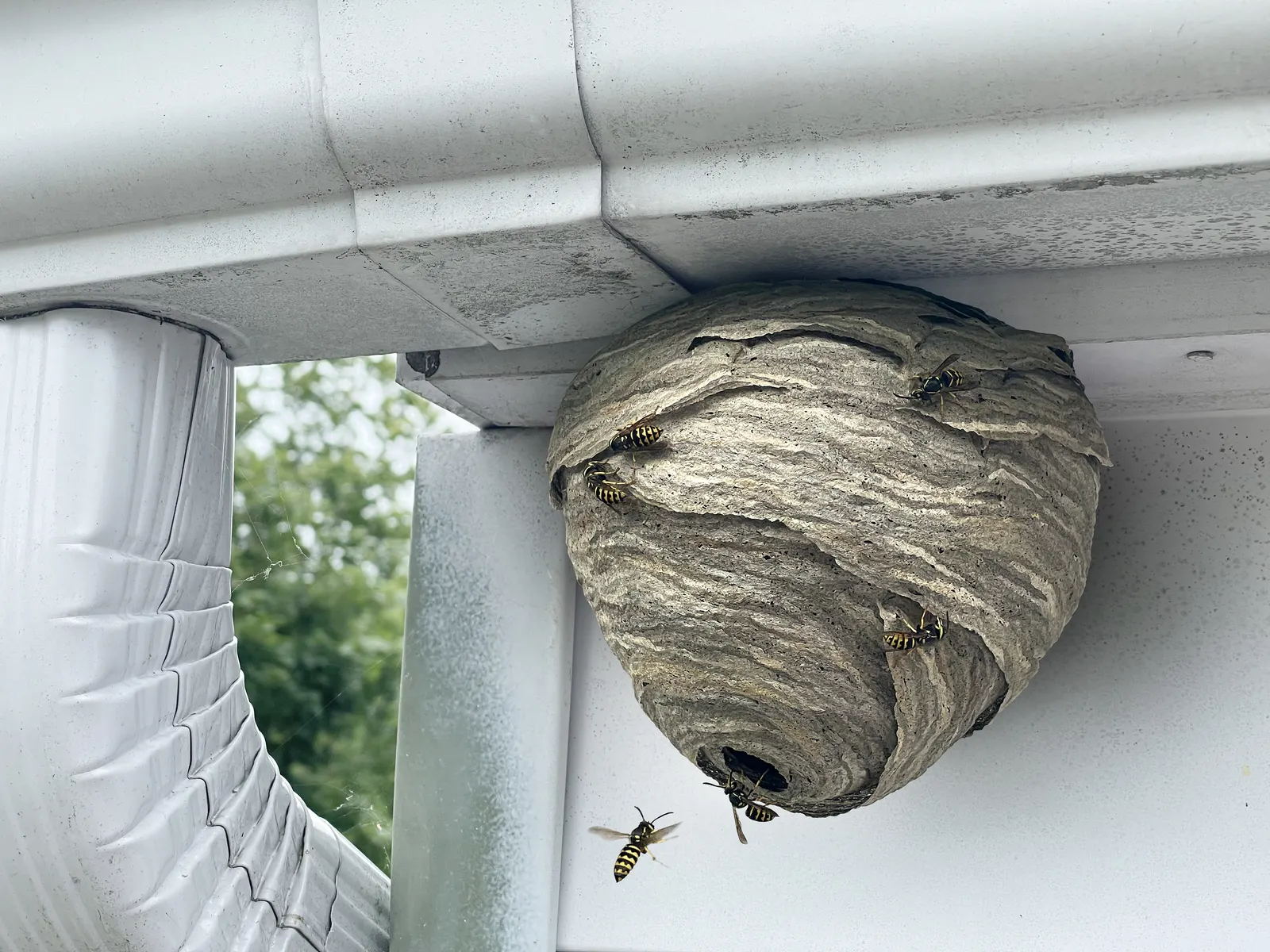
Stinging insects are the pest category where identification isn’t academic — it’s a safety call. A paper wasp comb over the garage door, a gray football in the maple, and a hole in the lawn that hums are three different levels of risk, and the worst injuries every summer come from treating the third like the first. Learn the nest shapes and you’ll know, at a glance, what you’re dealing with and whether it’s a Saturday job or a professional one.
Identification by nest — the reliable method
Paper wasps build the nest everyone recognizes: an open umbrella of hexagonal cells, hanging by a stalk under eaves, porch ceilings, shutters, railings, and grill lids. Colonies are small — dozens, not thousands — and the wasps (slender, long-legged, brown or red-and-yellow depending on region) are only defensive within a few feet of the comb. This is the least dangerous of the group, and the only one where careful DIY on a small early-season nest is defensible.
Bald-faced hornets build the dramatic one: an enclosed gray paper football, sometimes soccer-ball sized or larger, hanging in a tree, shrub, or under a high eave. Inside are several hundred black-and-white wasps that defend a generous radius around the nest and — unpleasant bonus — can squirt venom at the eyes of a perceived threat. These nests look inert; they are not. No DIY.
Yellow jackets are the ones that fill emergency rooms. The nest is hidden — in an old rodent burrow in the lawn, in a wall void, behind siding, in an attic or crawl space — and by late summer can hold thousands of workers. What you see is only the entrance: a steady traffic of stocky, bright yellow-and-black insects flying a straight line in and out of a hole. Yellow jackets defend aggressively, sting repeatedly (no barbed stinger to lose), pursue much farther than people expect, and are responsible for the large majority of serious stinging incidents — most classically via lawnmower.
Worth separating from all three: honey bees (fuzzy, golden-brown, legs carrying pollen) are pollinators, not pests. A colony in a wall needs a beekeeper’s relocation, not an exterminator — killing it leaves melting honeycomb in the void, which is its own disaster. We identify before we treat, and we refer honey bees out as policy.
The seasonal clock — and why timing is your best weapon
Every colony in this group starts from a single overwintered queen in spring. The comb she starts in April is golf-ball sized with a handful of workers; by July it’s fully staffed; by September it’s at maximum population and maximum defensiveness, with nothing left to lose. The practical rule follows directly: address nests early, when they’re small, and treat late-summer nests with real respect. (After hard frost, colonies die on their own — only the new queens overwinter — so a November nest is usually empty theater.)
This is also the logic of prevention: our recurring service includes knocking down new nest starts on eaves, shutters, decks, and play structures on every visit through the season — cheap insurance against ever meeting the September version.
Where DIY ends
A small, early paper wasp comb you can reach without a ladder: dusk (wasps are home and sluggish), long-range aerosol, exit route planned. That’s the full extent of the reasonable DIY envelope. Outside it:
- Anything requiring a ladder. Falls from ladders during panicked retreats cause worse injuries than the stings.
- Ground nests. Pouring gasoline in the hole is an environmental hazard that often fails; spraying the entrance mostly produces angry survivors.
- Wall-void nests. The critical one: sealing or spraying the exterior hole can drive thousands of yellow jackets into the house through interior gaps. This scenario, specifically, is why professionals exist.
- Bald-faced hornet nests. All of them.
- Anyone with a sting allergy anywhere nearby.
Professional removal — the core of our wasp and stinging insect service — uses proper protective equipment, products and application methods matched to the nest type, and removal of nest material where practical so the site doesn’t invite next year’s queen.
Living alongside the rest
Keep trash and recycling lidded, pick up fallen fruit, don’t leave sweet drinks open at gatherings (and check cans before sipping — stings inside the mouth are medical events), and fill abandoned rodent burrows in the lawn each spring. The colonies you never host are the easiest ones to control.