
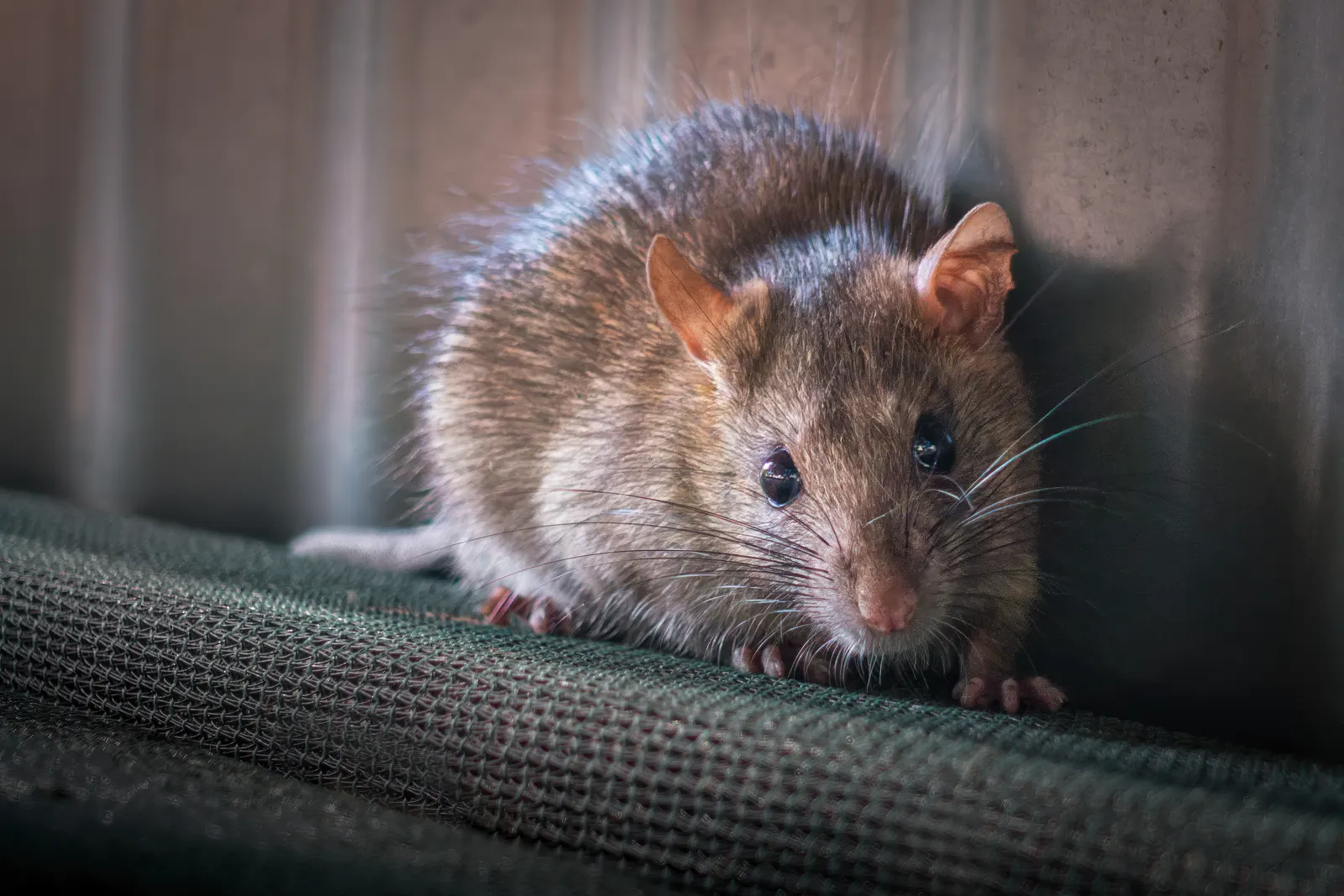
Rats are not big mice. They’re warier, stronger, more destructive, and far less forgiving of a casual response — a species pair that gnaws through wood and plastic, burrows under slabs, travels rooflines, and treats an amateur trapping campaign as an education. Knowing which rat you have, and thinking like it, is the difference between a solved problem and a winter-long siege.
Two rats, two completely different animals
Norway rats (brown rats, sewer rats) are the heavyweights — blunt-nosed, thick-bodied, with a tail shorter than the body. They live low: burrows in soil along foundations, under slabs and sheds, beneath woodpiles and dense ground cover, and in basements and crawl spaces. Outdoors, look for burrow openings two to four inches across with packed, polished entrances near a foundation line, fence row, or dumpster route.
Roof rats (black rats) are the acrobats — sleeker, pointed-nosed, with a tail longer than the body. They live high: attics, trees, vine-covered walls, and the utility lines they run like highways. In much of the South and along the coasts, the scratching-overhead problem is roof rats that walked a fence top or oak limb onto the roofline and entered at a construction gap, roof return, or vent.
The vertical split drives the inspection: look for burrows and ground-level access with Norway rats; roofline routes, overhanging limbs, and attic activity with roof rats. A control plan that ignores which rat is present is guessing.
Reading rat evidence
Droppings are raisin-sized — dramatically larger than a mouse’s. Gnaw marks are coarse, and rats defeat materials mice can’t: wood doors’ corners, plastic storage bins and trash cans, aluminum flashing. Rub marks along their runways are heavy and greasy — rats run the same routes nightly with an oily coat. You may find burrows (Norway) or hear solid nighttime movement in the attic (roof). And rats need open water more than mice do — dripping spigots, pet bowls, birdbaths, and AC condensate lines all matter to them.
The stakes are also a league up: rats gnaw electrical wiring (a documented fire cause), undermine slabs and patios with burrow systems, contaminate anywhere they travel, and carry the pathogen list that made their historical reputation.
Why rats humble DIY trapping
Mice are curious; rats are paranoid. Neophobia — hardwired suspicion of anything new — means a rat may skirt a fresh trap for a week, and a trap that snaps without killing teaches the whole colony’s survivors something you’ll regret. Effective rat trapping is a discipline: identify the runways, pre-bait unset traps until rats feed confidently, then set everything at once for a decisive knockout. Loose poison is worse than amateur trapping — genuinely dangerous to pets, children, and the owls and hawks that eat poisoned rodents, and a rat dying in a wall void is a weeks-long problem you can’t unsmell.
Even done well, trapping only removes the current tenants. Rats leave scent trails that advertise a proven route to every rat that follows. The route is the problem.
Treatment and prevention
Our rodent control service treats rats as a building-and-grounds problem. The inspection looks for activity and likely entries — a rat needs only a quarter-sized gap — from foundation vents and garage-door corners up through roof returns, soffit gaps, and utility penetrations. We treat the active problem and explain prevention steps and repairs to consider. Structural sealing is available through our Dallas and Fort Worth teams when included in the local plan.
The grounds half is yours and matters more with rats than any other pest: garbage in tight-lidded metal cans, pet food never left out, bird-feeder spillage managed, woodpiles elevated and away from structures, ivy and dense ground cover thinned, fruit picked up from under trees, and — for roof rats — tree limbs trimmed to leave a six-foot gap from the roofline. Rats colonize properties that feed and shelter them; make yours the worst option on the block.
When to call
With rats, promptly. Populations entrench quickly, burrow systems expand, wary survivors of failed DIY campaigns get harder to remove, and gnawed wiring doesn’t wait. A professional can identify the species, inspect likely routes, treat the current activity, and explain what property repairs may help prevent new activity.